🔮 Ancient Divination Tool
Ask the Pendulum
Focus your mind. Hold a clear yes-or-no question in your thoughts. When ready, ask — and let the pendulum reveal the answer.
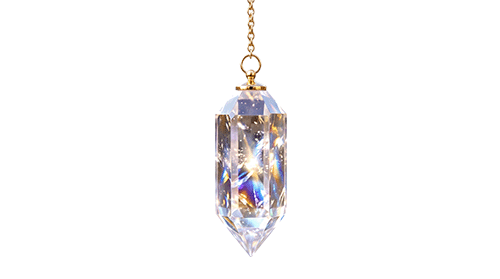
Click the crystal or the button — hold your question in mind
Ancient Wisdom
The History of the Pendulum
One of humanity's oldest divination tools — trusted across cultures and centuries.
Ancient Origins
Pendulum dowsing dates back over 5,000 years. Ancient Egyptians used weighted strings to locate water, gold, and make decisions. Cave paintings in the Tassili n'Ajjer region of Algeria — estimated at 8,000 years old — depict figures holding what appear to be divining rods and pendulums.
Science & Ideomotor Effect
Modern science explains the pendulum's movement through the ideomotor effect — tiny, unconscious muscular movements driven by your subconscious mind. The conscious mind asks; the subconscious knows. The pendulum acts as a bridge, amplifying micro-movements your body already produces in response to your deeper knowing.
Cross-Cultural Practice
From Chinese geomancers to European Renaissance physicians, pendulum dowsing has appeared in virtually every culture. In the 17th century, German Jesuit priest Athanasius Kircher documented dozens of pendulum experiments. French Catholic clergy used it to locate underground water. Native American shamans carried crystal pendulums as sacred healing tools.
Why Pendulums Are Accurate
The pendulum doesn't predict the future — it reveals your inner truth. Research in intuition and cognitive science shows that humans often know the right answer before consciously articulating it. The pendulum bypasses rational over-thinking, allowing your body's wisdom to express itself. Many practitioners report accuracy rates well above chance for binary yes/no decisions.
Back & Forth = YES
A linear oscillation — swinging toward and away from you, or side to side along one axis — has historically meant YES in most dowsing traditions. It mimics a nodding head.
Circular = NO
A rotational or conical movement — the tip tracing a circle — has historically indicated NO. The circular motion represents evasion or resistance to the question.
Step-by-Step Guide
How to Use a Pendulum Properly
Ground & Center Yourself
Before asking, take three slow breaths. Release distraction and bring your full awareness to the present moment. A scattered mind produces scattered results.
Ask a Clear Yes/No Question
The pendulum answers binary questions. "Will I get the job?" works. "What should I do with my life?" does not. Be specific, honest, and emotionally neutral — detachment from the outcome produces the clearest answers.
Hold the Intention, Not the Outcome
As you ask, release any preference for yes or no. Your desire to get a certain answer can influence the ideomotor response. Simply hold the question with curiosity.
Observe Without Forcing
Let the pendulum move on its own — never consciously guide it. Watch the direction and degree of motion. A strong swing signals a confident answer; a weak or circular motion may indicate uncertainty or that the question needs rephrasing.
Trust, Then Verify
Use the pendulum as one input, not the final word. Cross-reference its answer with logical reasoning and your own gut feeling. Over time, tracking your readings builds a map of where the pendulum aligns with your life.
Ready to go deeper? Combine the pendulum's wisdom with a full personalized reading.
Get My Full Reading